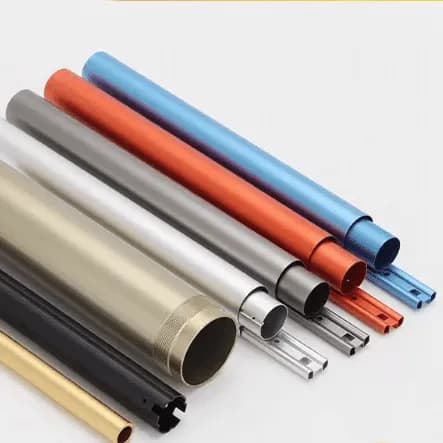
What Is Anodizing?
Anodizing is an electrochemical passivation process used to increase the thickness of the natural oxide layer on metal surfaces, enhancing durability and aesthetics. It works particularly well for aluminum and its alloys, though titanium, magnesium, stainless steel, and other non-ferrous metals can also be anodized.
Working Principle: The Oxide Layer "Grows" Rather Than Being "Applied"
Basic Process Steps:
- Cleaning & Pretreatment: Remove oil, oxide, and contaminants from the metal surface to ensure uniform anodizing
- Electrolytic Reaction: The metal part is immersed in an acidic electrolyte (e.g., sulfuric acid) and connected to the positive terminal of a power source (anode). An inert cathode (e.g., stainless steel) is placed in the electrolyte
- Oxide Layer Formation: Direct current passes through the electrolyte, oxygen ions migrate to the anode surface and react with metal atoms to form an oxide layer
- Structure: The layer grows inward and outward from the base metal, with a porous outer layer and a dense inner layer, ensuring strong adhesion and post-processing capabilities
- Coloring & Sealing (Optional): The porous layer can absorb dyes or metal salts for coloring. A sealing step in hot water or nickel salt solution closes the pores, improving corrosion resistance and preventing fading
Key Reactions (Using aluminum as an example):
- Anodic oxidation: 2Al → 2Al³⁺ + 6e⁻
- Oxide formation: 2Al³⁺ + 3H₂O → Al₂O₃ + 6H⁺
The resulting aluminum oxide (Al₂O₃) layer is dense and its thickness can be precisely controlled by current density and processing time.
Why Is the Anodized Layer So Durable?
Unlike coatings that are applied externally (e.g., painting or plating), the anodized layer grows from the substrate itself, partially penetrating the surface. This integrated structure ensures exceptional adhesion and durability.
How Is Thickness Controlled?
Thickness is influenced by factors such as current density, voltage, time, electrolyte concentration, and temperature. For aluminum, a widely used industry guideline is the 720 Rule: 720 amp-minutes per square foot of aluminum yields approximately 1 mil (0.001 inch or 25.4 µm) of oxide layer.
Types of Anodizing
| Type | Electrolyte | Thickness | Features |
|---|---|---|---|
| Type I (Chromic Acid) | Chromic acid | Thin (<5µm) | Superior corrosion resistance, used in aerospace |
| Type II (Sulfuric Acid) | Diluted sulfuric acid | Medium (5-20µm) | Decorative, dyeable, common in consumer goods |
| Type III (Hard Anodizing) | Concentrated sulfuric acid, low temperature, high current | Thick (25-100µm) | Excellent wear resistance, used in industrial parts |
What Is Electroplating?
Electroplating is the process of depositing a layer of metal onto a substrate by reducing metal ions in an electrolyte using direct current. Also known as electrochemical deposition, it forms a functional or decorative coating on the surface.
How It Works:
- The workpiece is the cathode (negative electrode)
- The anode (positive electrode) can be made of the plating metal (sacrificial anode) or inert material like graphite or platinum
- When electricity flows through the electrolyte containing metal ions, the metal ions are reduced at the cathode, forming a metallic coating
Faraday's Law describes the relationship between the amount of deposited metal and the total electric charge passed.
Electroplating is used to deposit single or alloyed metals like copper, nickel, chromium, zinc, gold, and silver. Though metal substrates are common, plastics and other non-conductive materials can be electroplated after pretreatment.
The ability to precisely control the thickness and properties of the coating makes electroplating ideal for parts requiring specific functional or aesthetic characteristics.
Anodizing vs. Electroplating
| Feature | Anodizing | Electroplating |
|---|---|---|
| Coating Type | Oxide (usually of the base metal) | Metal or alloy (different from the substrate) |
| Main Purpose | Protection, corrosion resistance, wear resistance, sometimes decoration, insulation | Protection, corrosion resistance, wear resistance, conductivity, decoration, thickness buildup |
| Thickness Range | nm to ~50 µm (depending on type) | Sub-µm to mm (highly controllable) |
| Bond Strength | Excellent (integral with the base metal) | Good (depends on surface preparation and material compatibility) |
| Common Materials | Aluminum, titanium, magnesium, zinc, copper, manganese, stainless steel | Zinc, nickel, copper, chromium, gold, silver, tin, cadmium, brass, iron, titanium |
The fundamental difference in coating formation—conversion vs. deposition—leads to many subsequent distinctions in performance and applications.
Common Applications of Anodizing
Aerospace
In the aerospace industry, anodized aluminum is employed for aircraft structural components, fasteners, and other parts exposed to harsh environments due to its excellent corrosion resistance. Components such as helicopter rotor blades, landing gear, and hydraulic control systems benefit from the enhanced wear resistance and durability provided by anodizing. Additionally, anodized aluminum is used for electrical insulation and heat dissipation in avionics and aerospace instrumentation.
Architecture
In the field of architecture, anodized aluminum is extensively used for building exteriors due to its weather resistance and long-term durability. Applications include storefronts, curtain walls, roofing systems, and window and door frames. Its wide range of color and finish options, along with excellent fade resistance, make it highly desirable for aesthetic designs.
Consumer Electronics
In consumer electronics, anodized aluminum is commonly used for protective casings and covers of devices such as smartphones, laptops, and computers, providing scratch and corrosion resistance. Its good thermal conductivity also makes it suitable for heat dissipation in electronic components. Furthermore, anodizing enables attractive colored finishes that enhance the visual appeal of products.
Common Applications of Electroplating
Automotive Industry
In the automotive sector, electroplating is primarily used for corrosion protection of various components such as bumpers, grilles, rims, exhaust systems, fasteners, chassis parts, braking systems, and under-the-hood elements. Zinc and zinc-nickel coatings are commonly applied for their excellent corrosion resistance. Electroplating also enhances the aesthetics of interior and exterior automotive trim—typically using chromium, nickel, or gold finishes.
Electronic Components
In the electronics industry, electroplating is widely used to enhance the conductivity of connectors, contacts, switches, and printed circuit boards, with gold, silver, and copper being the most common plating metals. It also provides corrosion resistance to ensure the long-term reliability of electronic devices.
Jewelry
Electroplating is extensively used in the jewelry industry to coat base metals with precious metals such as gold, silver, or rhodium. This not only reduces costs but also enhances the visual appeal and perceived value of jewelry. Electroplating provides a protective layer to prevent tarnishing and wear.
Advantages and Disadvantages of Anodizing
Advantages
Anodizing offers several key benefits, primarily the formation of a hard oxide layer that enhances durability and wear resistance. The oxide layer also provides excellent corrosion resistance. Through dyeing, anodized aluminum can achieve vibrant and long-lasting colors. Anodizing extends the service life of aluminum products. The process is relatively environmentally friendly, as it does not involve heavy metals or produce toxic waste, and anodized aluminum is recyclable. Thanks to its porous surface, anodized aluminum improves the adhesion of paints, coatings, and lubricants. It also provides electrical insulation (non-conductive surface).
Disadvantages
Anodizing is mainly applicable to aluminum and certain other non-ferrous metals. Compared to other surface treatments, color choices may be limited, and achieving precise color matching can be challenging due to variations in aluminum alloys. Some colors may fade over prolonged UV exposure. Anodized coatings can be brittle and may crack under stress or during forming. The process affects part dimensions, which must be accounted for during design. Repairing colored anodized surfaces can be difficult and noticeable.
Advantages and Disadvantages of Electroplating
Advantages
Electroplating primarily improves corrosion resistance by applying a protective layer of less reactive metal. It enhances appearance by adding shiny or decorative metals such as gold, silver, or chrome. It improves conductivity by depositing highly conductive metals like gold and silver—critical for electronic components. Low-friction metals can be plated to improve wear resistance and reduce friction. Electroplating is highly versatile, suitable for a wide range of substrates (both metals and plastics), and supports many different plating metals.
Disadvantages
Electroplated coatings may suffer from poor adhesion due to inadequate surface preparation or incompatible materials, leading to peeling or flaking. Hydrogen embrittlement—a condition where hydrogen absorbed during plating weakens and cracks the metal—is especially problematic for high-strength steels. Waste generated during electroplating, including spent electrolytes and rinse water containing metal ions and chemicals, can pose environmental challenges. Some processes use hazardous substances such as cyanide. Achieving uniform coating thickness can be difficult due to variations in current density across complex geometries.
Conclusion: Choosing the Right Surface Treatment
Anodizing and electroplating are two essential metal surface treatment techniques with distinct principles and applications. Anodizing converts the metal surface into an oxide layer, while electroplating deposits another metal onto the surface.
Anodizing is ideal for aluminum and certain non-ferrous metals when corrosion resistance, wear resistance, aesthetics, and integral coatings are required. It is commonly used in aerospace, architecture, and consumer electronics—industries where lightweight, durability, and appearance are crucial.
Electroplating, on the other hand, is suitable for a wider range of metals and even plastics. It is often chosen for applications that require specific surface properties such as enhanced conductivity, lubrication, or a particular metallic finish. It is widely used in automotive, electronics, and jewelry industries.
In conclusion, anodizing and electroplating are both highly valuable surface treatment technologies. Each offers unique advantages and serves a wide range of applications, depending on specific project requirements.